
In the Philippines, managing utang (debt) has become a normal part of everyday life. Millions of Filipinos rely on credit cards and personal loans (pautang online, salary loans, or bank financing) to cover emergencies, daily expenses, and even lifestyle upgrades. But when you need extra cash, which option is really better: a credit card or a loan?
- Understanding the Basics of Credit Cards and Loans
- Key Differences Between Credit Cards and Loans
- Pros and Cons of Credit Cards
- Pros and Cons of Loans
- When Should You Use a Credit Card?
- When Should You Take a Loan?
- Credit Card vs Loan — Which One Is Better for You?
- Credit Card vs Loan — Real-Life Examples in the Philippines
- Tips for Managing Credit Cards and Loans Wisely
- FAQ — Credit Cards vs Loans in the Philippines
- Is it cheaper to get a personal loan or use a credit card?
- Can I use a credit card for a cash loan?
- What is the best loan for emergency needs in the Philippines?
- Do credit cards have lower interest than pautang online?
- Which is better for debt consolidation — credit card balance transfer or loan?
- How can I avoid getting trapped in utang?
- Are online lending apps safe to use in the Philippines?
- Conclusion
This guide will walk you through the differences, advantages, disadvantages, and best use cases of credit cards vs loans in the Philippines. By the end, you’ll know which tool fits your financial situation — and how to use it wisely without falling into a debt trap.
Understanding the Basics of Credit Cards and Loans
What Is a Credit Card?
A credit card is a revolving line of credit that allows you to borrow money up to a set limit. You can use it for shopping, bills, travel, or even cash advances. Each month, you’re required to pay at least a minimum balance, while the remaining amount accrues interest if not paid in full.
Key points:
- Borrow anytime within your credit limit.
- Pay minimum balance or full balance each month.
- Interest rates average 2–3% per month in the Philippines.
- Best for flexible spending and short-term needs.
What Is a Loan?
A loan is a fixed amount of money borrowed from a lender (bank, online lending app, cooperative, or salary loan provider) that must be repaid in installments over a set period.
Types of loans in the Philippines:
- Personal loans (bank financing, multipurpose)
- Salary loans (GSIS, SSS, Pag-IBIG, employer financing)
- Online lending apps (pautang online)
- Business loans & start-up financing
Key points:
- Lump sum amount is disbursed once approved.
- Repayment is structured with equal monthly installments.
- Interest rates vary between 1–3% monthly add-on, depending on lender.
- Best for long-term expenses and major financial goals.
Key Differences Between Credit Cards and Loans
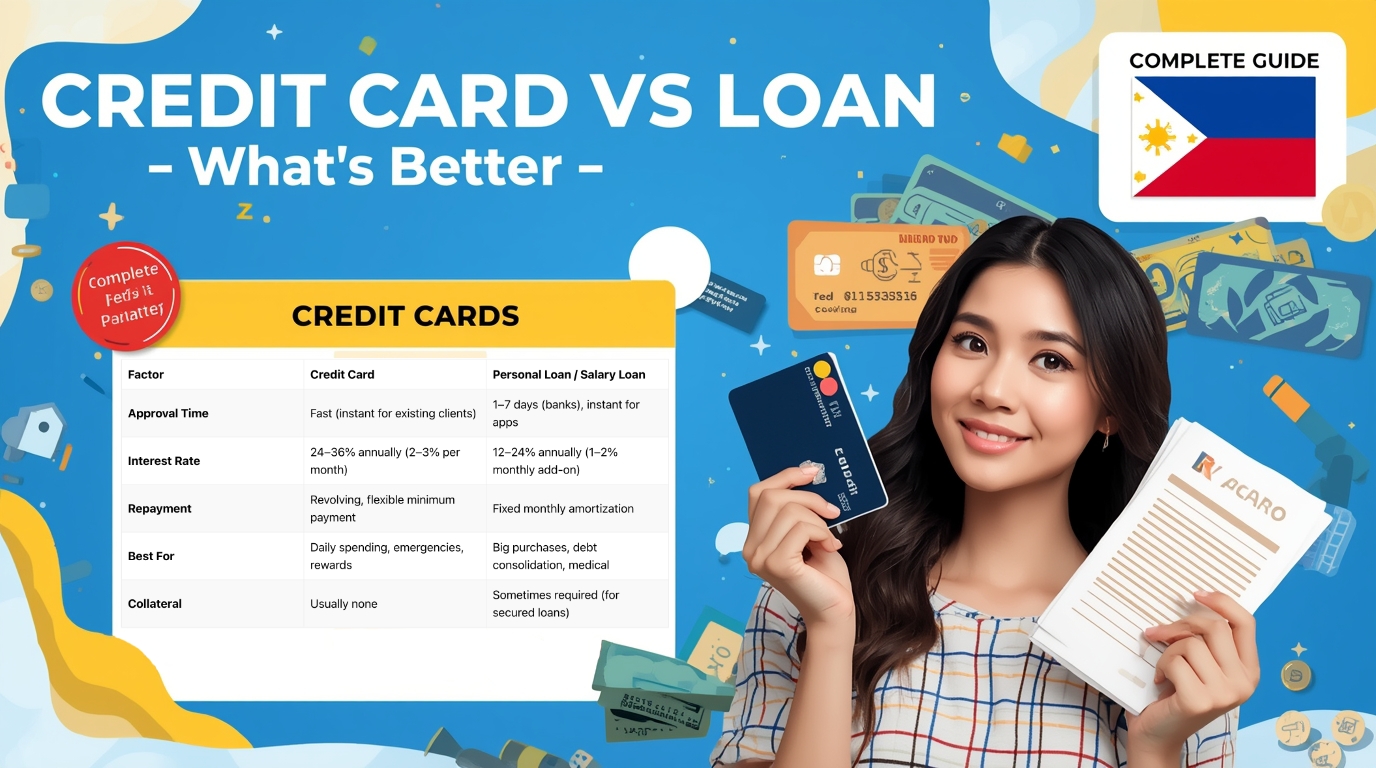
| Factor | Credit Card | Personal Loan / Salary Loan |
| Approval Time | Fast (instant for existing clients) | 1–7 days (banks), instant for apps |
| Interest Rate | 24–36% annually (2–3% per month) | 12–24% annually (1–2% monthly add-on) |
| Repayment | Revolving, flexible minimum payment | Fixed monthly amortization |
| Best For | Daily spending, emergencies, rewards | Big purchases, debt consolidation, medical |
| Collateral | Usually none | Sometimes required (for secured loans) |
💡 Quick insight: Credit cards offer flexibility but come with high interest. Loans provide structure and usually lower rates, but less flexibility.
Pros and Cons of Credit Cards
Advantages of Credit Cards
- Convenience — Accepted everywhere, both online and offline.
- Rewards & perks — Cashback, airline miles, discounts.
- Emergency use — Instant access to cash or credit.
- Credit score building — Helps you qualify for bigger loans in the future.
Disadvantages of Credit Cards
- High interest rates (if you don’t pay in full).
- Hidden fees — Annual fees, late charges, over-limit fees.
- Risk of overspending — Easy access can lead to a utang spiral.
- Cash advance fees — Higher rates when withdrawing cash.
Pros and Cons of Loans
Advantages of Loans
- Lower interest rates compared to credit cards.
- Structured repayment — Fixed monthly installments, easier budgeting.
- Lump sum disbursement — Suitable for large expenses like tuition, medical bills, or debt consolidation.
- Longer repayment terms (6 months to 5 years).
Disadvantages of Loans
- Longer approval process (banks may require documents, collateral, or credit checks).
- Fixed obligation — Monthly repayment is required, no flexibility.
- Penalties for missed payments can be severe.
- Processing fees reduce the amount you actually receive.
When Should You Use a Credit Card?
- Everyday expenses like groceries, bills, and transport.
- Travel perks — earn airline miles or hotel discounts.
- Online shopping and subscriptions.
- Emergency cash advances, if no other option.
⚠️ Tip: Only use credit cards if you can pay the full balance on time. Otherwise, interest charges will pile up quickly.
When Should You Take a Loan?
- Debt consolidation — combine multiple high-interest debts into one manageable loan.
- Medical emergencies — when hospital bills exceed your savings.
- Education & tuition fees — financing college or training.
- Business start-ups — capital for SMEs and online sellers.
- Home improvements — long-term investment in property.
Credit Card vs Loan — Which One Is Better for You?
Based on Purpose
- Credit Card — Best for short-term, everyday, or unexpected expenses.
- Loan — Best for large, one-time costs with longer repayment.
Based on Cost
- Credit cards charge higher monthly interest (2–3%).
- Loans usually have lower effective annual rates.
Based on Discipline
- If you struggle with overspending, a loan is safer because it forces structure.
- If you’re disciplined and pay in full, a credit card offers more perks.
Credit Card vs Loan — Real-Life Examples in the Philippines
- Juan’s Story: Juan used his credit card for groceries and dining out. He only paid the minimum each month. After 6 months, his utang doubled due to interest and fees.
- Maria’s Story: Maria took a salary loan for her child’s hospital bills. She paid monthly deductions through payroll, which helped her stay disciplined and avoid ballooning debt.
Moral: It’s not about which is “better,” but which suits your financial behavior.
Tips for Managing Credit Cards and Loans Wisely
- Compare rates before applying.
- Never borrow more than 30% of your monthly income.
- Pay on time to avoid penalties.
- For pautang online, always check if the lender is BSP-registered.
- Avoid using multiple credit cards or overlapping loans.
FAQ — Credit Cards vs Loans in the Philippines
Is it cheaper to get a personal loan or use a credit card?
In most cases, a personal loan is cheaper because banks charge lower effective annual rates compared to credit cards’ 24–36% APR.
Can I use a credit card for a cash loan?
Yes. This is called a cash advance, but fees are high (3–5% of amount + higher interest). Use only in emergencies.
What is the best loan for emergency needs in the Philippines?
Salary loans (SSS, GSIS, Pag-IBIG) or licensed online lending apps are often the fastest for emergencies.
Do credit cards have lower interest than pautang online?
Yes, generally credit cards charge 2–3% monthly, while many online lending apps can charge higher (up to 10–15% per month).
Which is better for debt consolidation — credit card balance transfer or loan?
A personal loan is better for large balances. Balance transfers work if you can repay quickly within promo periods (0% interest for 6–12 months).
How can I avoid getting trapped in utang?
- Borrow only for needs, not wants.
- Always pay more than the minimum.
- Track all due dates.
Are online lending apps safe to use in the Philippines?
Yes, but only use BSP-licensed and SEC-registered apps. Avoid loan sharks and unlicensed apps.






Conclusion
Both credit cards and loans are useful financial tools. Credit cards are ideal for flexible, short-term spending, while loans are better for structured, long-term needs. The choice depends on your goal, cost, and financial discipline.
Compare the best loan apps in the Philippines →