

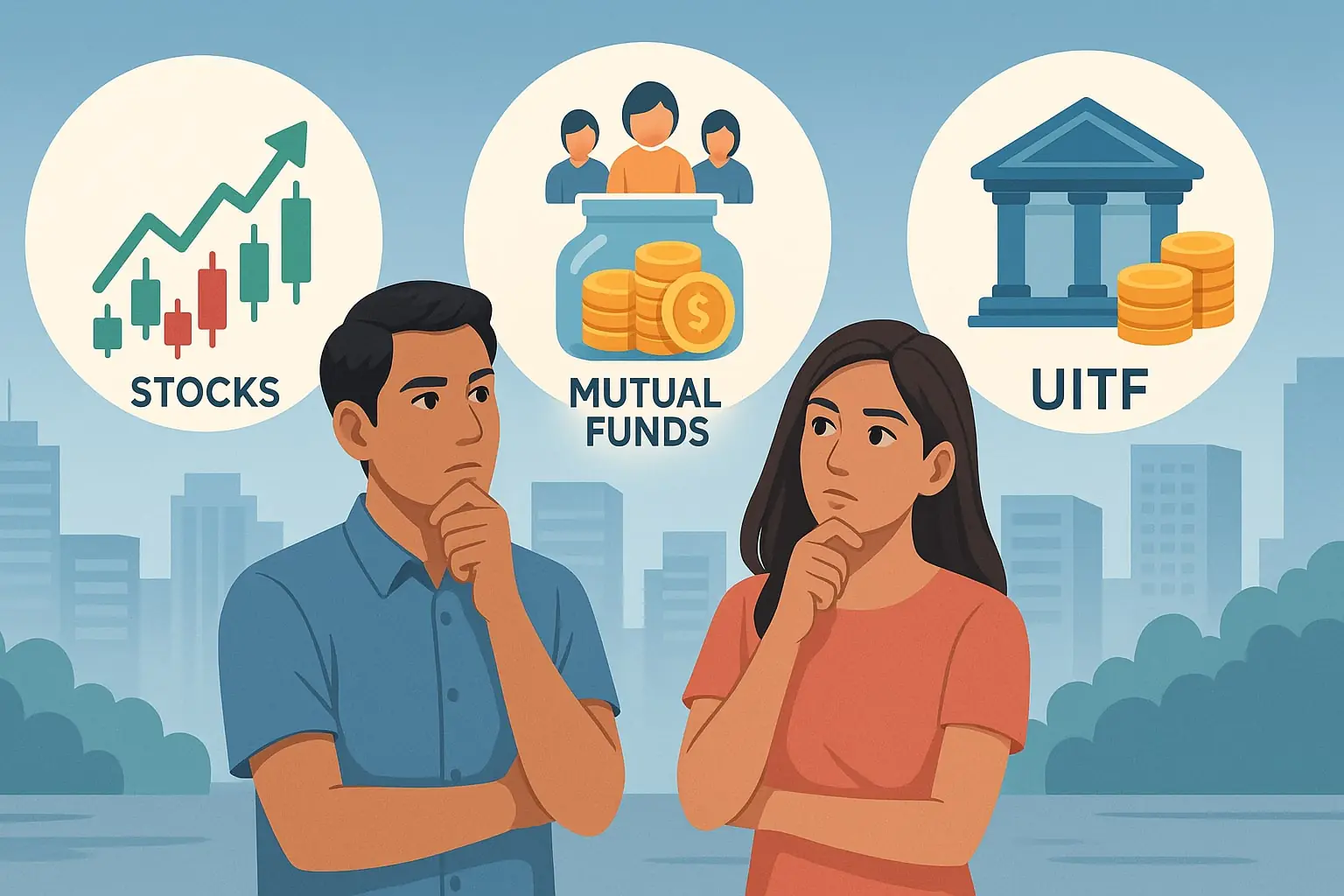
For many Filipinos who want to start investing, the most common question is: “Should I put my money in stocks, mutual funds, or UITFs?” Each option offers different levels of risk, return, and convenience.
- What Are Stocks, Mutual Funds, and UITFs?
- Key Differences: Stocks vs Mutual Funds vs UITF
- Pros and Cons of Each Option
- Which Investment Should You Choose?
- Risk and Return Comparison
- How to Start Investing
- FAQ
- What is the main difference between mutual funds and UITFs?
- Can I invest in both stocks and mutual funds?
- Are UITFs safe?
- How much do I need to start investing?
- Which gives higher returns?
- Can OFWs invest in mutual funds or UITFs?
- Are there hidden fees?
- Conclusion
If you’re a beginner saving part of your sweldo (salary), an OFW investing remittances, or someone looking to grow beyond a savings account, this guide will help you understand the differences between stocks, mutual funds, and UITFs so you can decide which is best for you.

What Are Stocks, Mutual Funds, and UITFs?
Stocks
- Buying shares of a company listed on the Philippine Stock Exchange (PSE).
- Example: Jollibee (JFC), Ayala Land (ALI), SM Investments (SM).
- Your profit comes from capital appreciation (price increase) and dividends.
Best for: Long-term investors willing to study the market.
Mutual Funds
- A pooled investment managed by professional fund managers.
- Investors buy “shares” in the fund.
- Regulated by the Securities and Exchange Commission (SEC).
Best for: Beginners who want professional management and diversification.
UITFs (Unit Investment Trust Funds)
- Similar to mutual funds but offered by banks.
- Investors buy “units” instead of shares.
- Regulated by the Bangko Sentral ng Pilipinas (BSP).
Best for: People who already have a bank account and want easy access.

Key Differences: Stocks vs Mutual Funds vs UITF
| Feature | Stocks | Mutual Funds | UITFs |
| Who manages? | You | Fund manager | Bank trust professionals |
| Regulation | PSE & SEC | SEC | BSP |
| Starting capital | ₱5,000+ | ₱1,000–₱5,000 | ₱1,000–₱10,000 |
| Risk level | High | Medium | Medium |
| Liquidity | Sell anytime during trading | 3–7 banking days to redeem | 1–7 banking days to redeem |
| Accessibility | Stock broker apps | Investment companies | Major banks |
| Best for | DIY investors, active traders | Beginners, long-term savers | Bank clients, passive investors |
Pros and Cons of Each Option
Pros of Stocks
✅ High return potential
✅ Dividends possible
✅ Full control of portfolio
Cons:
❌ High risk
❌ Requires market knowledge
❌ Emotional decisions can lead to losses
Pros of Mutual Funds
✅ Professional management
✅ Diversified portfolio
✅ Affordable starting capital
Cons:
❌ Management fees
❌ Limited control over holdings
❌ Redemption takes days
Pros of UITFs
✅ Easy to invest through banks
✅ Professionally managed
✅ Flexible investment products (equity, bond, balanced funds)
Cons:
❌ Fees may apply
❌ Not insured by PDIC (not like deposits)
❌ Returns not guaranteed
Which Investment Should You Choose?
Choose Stocks If:
- You want full control.
- You’re willing to study the market.
- You have higher risk tolerance.
Choose Mutual Funds If:
- You’re a beginner.
- You prefer experts to manage your money.
- You want instant diversification.
Choose UITFs If:
- You already have a bank account.
- You want a hands-off investment.
- You want flexible options without opening a brokerage.
Risk and Return Comparison
| Investment Type | Potential Returns | Risk Level | Example Time Horizon |
| Stocks | 8–15% annually | High | 5–10 years |
| Mutual Funds | 6–10% annually | Medium | 3–7 years |
| UITFs | 5–10% annually | Medium | 3–7 years |
| Savings Account | 0.25–1% annually | Very Low | Short-term only |
How to Start Investing
- Set your financial goals – retirement, education, house purchase.
- Decide your risk appetite – conservative, moderate, aggressive.
- Choose a platform – COL Financial (stocks), Sun Life (mutual funds), BPI/BDO (UITFs).
- Start small – as low as ₱1,000.
- Stay consistent – invest monthly, not just once.






FAQ
What is the main difference between mutual funds and UITFs?
Mutual funds are regulated by the SEC and managed by investment companies, while UITFs are offered by banks and regulated by the BSP.
Can I invest in both stocks and mutual funds?
Yes. Many investors diversify by having both — stocks for growth and funds for stability.
Are UITFs safe?
They’re managed by banks and professionals, but not insured by PDIC. Returns depend on market performance.
How much do I need to start investing?
- Stocks: ₱5,000+
- Mutual Funds: ₱1,000–₱5,000
- UITFs: ₱1,000–₱10,000
Which gives higher returns?
Historically, stocks offer higher returns but with more risk. Funds (mutual/UITF) give more stable but moderate returns.
Can OFWs invest in mutual funds or UITFs?
Yes. Many banks and investment firms allow OFWs to invest online or through remittances.
Are there hidden fees?
Mutual funds and UITFs charge management fees (1–2% annually). Stocks have brokerage fees per trade.
Conclusion
Both stocks and funds (mutual or UITF) have their place in a Filipino investor’s portfolio. Stocks give higher growth potential but need time and knowledge. Mutual funds and UITFs are beginner-friendly, managed by professionals, and allow easy diversification.
The best choice depends on your goals, risk tolerance, and how much time you want to spend managing your investments.
Compare the best loan apps in the Philippines →